
S/4HANA Public vs. Private Cloud — Understanding the True Cost Picture
October 2, 2026 | by Rick Kromkamp
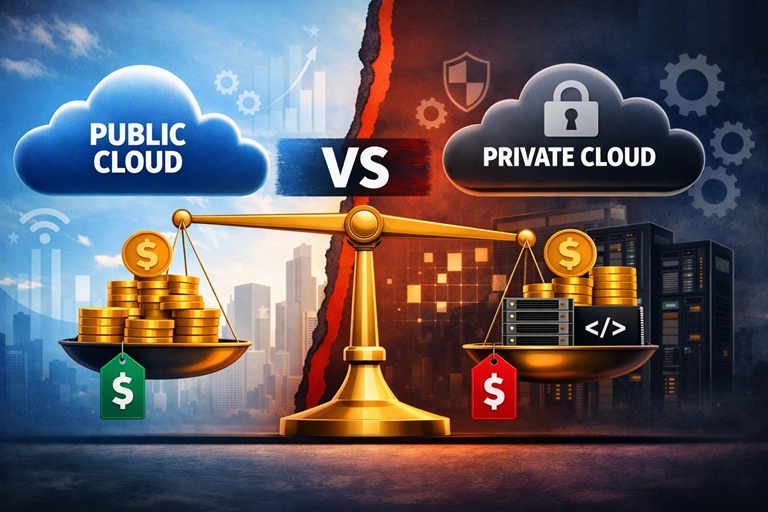
There’s a moment in every transformation conversation where someone leans back, folds their arms, and asks the question that seems simple but never is: “So… which one is cheaper?”
If only it were that easy.
Cost is one of the most misunderstood aspects of the S/4HANA Public vs. Private Cloud decision. On paper, Public Cloud looks like the obvious winner — lower subscription fees, SAP-managed upgrades, predictable operations. But as every seasoned SAP leader knows, total cost of ownership isn’t a line item. It’s a narrative. And like any good narrative, it has nuance, context, and a few plot twists.
Today, let’s walk through that narrative together — not as a spreadsheet exercise, but as a holistic, strategic conversation. Imagine you’re sitting in a TED Talk auditorium, lights dimmed, and we’re unpacking what really determines long-term cost, value, and ROI in your S/4HANA journey.
The Philosophy Behind the Price Tag
Before we talk numbers, we need to talk philosophy — because Public and Private Cloud weren’t designed to solve the same problem. Public Cloud is built for standardization, automation, and predictable operating costs. Private Cloud is built for flexibility, control, and compatibility with existing ECC investments. As the attached article notes,
These architectural differences ripple through every cost category. Public Cloud reduces infrastructure and operational overhead through multi‑tenant SaaS delivery. Private Cloud preserves customer-specific configurations and custom code, but requires dedicated infrastructure and more involved lifecycle management.
Understanding these philosophical roots is essential — because every cost implication that follows stems directly from them.
Annual Subscription Cost: The One Category With a Clear Winner
Let’s start with the simplest part of the story.
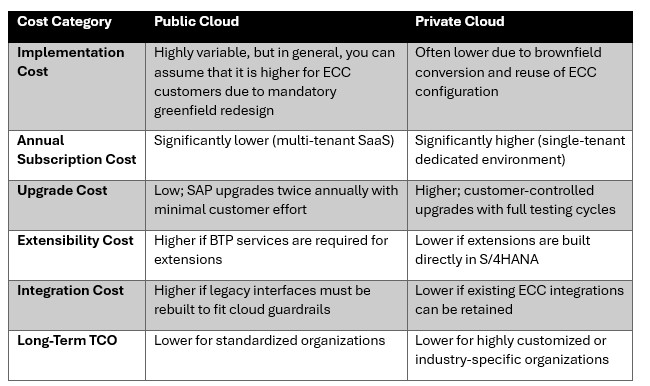
Public Cloud’s multitenant SaaS architecture dramatically reduces infrastructure, operations, and support costs. SAP manages upgrades, performance, security, and availability across all tenants. As a result, the annual subscription cost is substantially lower than Private Cloud—often by several orders of magnitude for larger landscapes.
Private Cloud, by contrast, is a dedicated environment. You pay for isolation, deeper functional scope, and extensibility freedom.
This is the one category where the answer is straightforward: Public Cloud wins. Every time.
Implementation Cost: The Category Everyone Gets Wrong
Public Cloud requires a full greenfield implementation — redesigning processes, rebuilding integrations, migrating data into a new tenant. Private Cloud allows brownfield conversion, preserving configuration, custom code, and integrations.
But here’s the twist: the cost difference is often smaller than people assume.
While Public Cloud requires redesign, the data migration and config costs in public are off-set by the basis costs in a private cloud migration.
In other words:
- Public Cloud costs more in data migration and redesign.
- Private Cloud costs more in technical conversion and basis work.
And in many real-world ECC environments, those two forces meet in the middle. SAP makes data migration from ECC much easier nowadays. Much of the configuration in ECC can be copied over to S/4HANA.
Private Cloud still has a slight edge — but not the dramatic one customers might expect.
Upgrade & Lifecycle Costs: The Silent TCO Divider
This is the category that determines long-term ROI more than any other.
Public Cloud upgrades twice per year. You don’t schedule them. You don’t negotiate them. You don’t run a six‑month regression marathon. You test lightly, validate, and move on.
SAP upgrades in public cloud are very tight, 4 week endeavours at most… This is a significant cost reduction and gives public cloud the clear edge in this category.
Private Cloud upgrades look more like traditional ECC upgrades — extended testing, custom code remediation, cross‑functional coordination. Predictable? No. Cheap? Also no.
This is where Public Cloud quietly builds a long-term financial advantage.
Extensibility & BTP Costs: The Category That Depends on Your DNA
Public Cloud enforces clean core. Extensions, workflows, and integrations often require SAP BTP. That means recurring platform costs.
Private Cloud allows classic ABAP extensibility. Many customers skip BTP entirely for extensions they can build directly in S/4HANA.
Organizations with extensive customization and interfaces in ECC will need to recreate those with clean core methods. As such, a brownfield private cloud implementation will be more cost effective in this category.
That said, this category isn't as much about cost as it is about identity. If your organization thrives on customization, Private Cloud will feel more natural and more economical, particularly if you have an existing internal support team with a long history of ECC enhancements. If you want standardization and guardrails, Public Cloud is the better long-term fit.
Integration Costs: The Hidden Multiplier
Public Cloud’s guardrails mean legacy interfaces often need to be rebuilt. Private Cloud allows many ECC integrations to be retained.
This is one of the most overlooked cost drivers — especially for organizations with decades of point-to-point interfaces.
Before starting any costing exercise for S/4HANA Cloud, take stock of ALL of your existing interfaces, and not just at a system level. Every interface constitutes a new custom development that needs to be considered.
Cost Comparison - A Summary
Final Thoughts: Cost Isn’t a Number — It’s a Strategy
Choosing between Public Cloud and Private Cloud is not a matter of identifying which option is “cheaper.” It’s about understanding the full cost landscape — subscription fees, implementation effort, upgrade behavior, extensibility strategy, and integration complexity — and aligning those realities with your organization’s long‑term roadmap.
Public Cloud delivers predictable operations, lower subscription costs, and streamlined upgrades. Private Cloud delivers flexibility, compatibility with ECC, and cost advantages for organizations with heavy customization or complex integrations.
The right answer depends on who you are as an organization and where you intend to go.
This article is the third installment in our broader series exploring the realities of moving to S/4HANA Cloud. You can read the other articles in the series here. In the next chapter, we’ll focus on what ECC customers should be doing today to prepare for their journey — whether that path leads to Public Cloud or Private Cloud.
If your organization is evaluating its S/4HANA strategy and wants expert guidance, CONTAX is here to help. Visit www.contax.com or contact info@contax.com to start the conversation.
About the Author

Rick Kromkamp
Related Articles
S/4HANA Public vs. Private Cloud — Understanding the Fundamentals
A practical overview of the key differences between SAP S/4HANA Public Cloud and Private Cloud to help choose the right path forward.
SAP Public Cloud vs. Private Cloud: Customization Isn’t Dead—It Just Grew Up
Think clean core means no customization? SAP Public Cloud proves you can still build smarter, faster, and cleaner—without breaking the core.

SAP Sapphire 2026: What Was Announced, What It Really Means, and How Organizations Should Move Forward
SAP showed us the future this week. What should organizations actually do next?